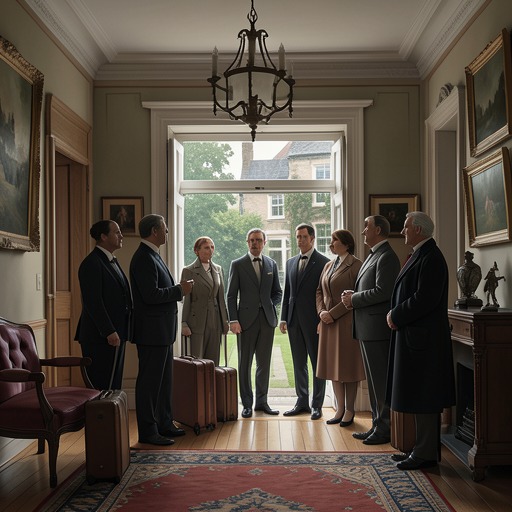
Dinner at La Raspelière
In Search of Lost TimeDinner at La Raspelière turns a country-house gathering into a study of social power in action: titles, seating, introductions, artistic taste, and hospitality all become ways of claiming or contesting rank. Its central encounter is between Baron de Charlus and the Verdurins, whose language of artistic fellowship does not mean the same thing to either party. The evening makes visible a society in which cultural distinction can challenge inherited status but cannot simply erase it.
Setting and Social Stakes
The dinner takes place at La Raspelière, where Madame Verdurin presides over a circle that values artistic distinction and its own sense of fellowship. The guests’ conversation ranges from food and etymology to music, noble precedence, and the place of titles. These subjects are not incidental diversions: each gives the participants a way to establish who is knowledgeable, who belongs, and whose standards should govern the room.
A Norwegian guest tries to ask Brichot about the botanical roots of place-names, but Madame Verdurin cuts the inquiry short because she wants the dinner to proceed. The guest explains that he must leave for Paris the next day, where his French colleague M. Boutroux is to speak about spiritualism, and then travel on to Algiers and the Cape. He seeks reassurance that Madame Verdurin’s table represents excellent French cooking. Her initial answer is cool; when he says that a visit next Wednesday would be better, she is mollified. The exchange shows how praise and prospective attendance can smooth over a breach in the hostess’s expectations, even as she retains control of the evening’s pace.
The guest then turns from conversation to eating, while Brichot continues supplying vegetable etymologies. The narrator’s note that he will pass one of the etymologies on to Céleste gives this learned performance a domestic afterlife, but the exchange also exposes the dinner’s uneven distribution of attention: the Norwegian guest alternately stops eating to listen and signals the servants to remove his untouched plate. Conversation, service, and appetite move according to separate rhythms within the same social gathering.
Charlus and the Meaning of Belonging
Madame Verdurin tries to establish intimacy with Charlus by telling him that he is one of her kind: an artist, or at least someone who belongs to the circle’s inner world. She distinguishes that world from ordinary social concerns and offers Dechambre, Brichot, and Morel as examples of those who do or do not qualify. Charlus reacts with a start. He hears her phrase through a different, private understanding, and her confidence in having recognized him makes the intended welcome unexpectedly unsettling.
Madame Verdurin’s definition of belonging is cultural rather than genealogical. Dechambre, though an accomplished pianist, was not one of her kind; Morel is, and so, she says, is she herself. Charlus’s momentary alarm gives way to reassurance when he understands the sense she intends. Yet the episode does not settle their differences. Their apparent agreement rests on incompatible meanings: the hostess is claiming a bond based on artistic and social affinity, while Charlus is alert to an implication she does not intend to state.
The attempt to classify Charlus as an artistic equal soon meets the question of rank. Verdurin explains that she has given the Marquis de Cambremer a better position because he is a marquis and Charlus only a baron. Charlus replies that he is also Duke of Brabant and Prince of Oléron, Carency, Viareggio, and the Dunes, among other titles, while professing that rank is of no importance to him. The contrast between his correction and his disclaimer is pointed: he says he does not care about precedence at the very moment he makes the room recognize the precedence it has overlooked.
The Performance of Aristocratic Precedence
Charlus extends his answer beyond a list of titles into a family history of precedence at court. He recalls that his family once held the Duchy of Aumale and describes an incident at the burial of Monsieur, when an ancestor challenged the Princess of Croy’s attempt to kneel after her. According to his account, the officer removed the hassock and the King required the Princess of Croy to apologize. He also recalls the family obtaining royal authority to have the ushers accompanying the Duke of Burgundy lower their batons.
These stories make hierarchy appear not as a vague inheritance but as a series of publicly enforced gestures: who may use a hassock, whose attendants carry raised batons, and who enters before whom. Charlus says that the family’s claim to precedence was established through centuries of service in war and later acknowledged at court. He recounts the King calling the Duchess of Guermantes ahead of the Princess of Baden, whose family connections were themselves distinguished. The anecdotes function as evidence in Charlus’s argument, converting ancestral privilege into a supposedly recognized rule of conduct.
That history stands in tension with the Verdurins’ dismissal of noble titles. Verdurin says that he attaches no importance to them, then explains the seating difference by pointing out that Cambremer is a marquis and Charlus only a baron. The contradiction demonstrates that rank remains active even when a host claims to have moved beyond it. Charlus’s insistence does not refute the dinner’s social order so much as reveal that the order is being negotiated through competing systems of value: noble descent on one side, artistic and social affiliation on the other.
A smaller test of precedence arises when Cambremer appears to offer Charlus his chair. Charlus interprets the gesture as recognition of a duty owed by a squire to a prince, then declines it with emphatic politeness, placing his hands on Cambremer’s shoulders to keep him seated. He says that such deference should be reserved for princes of the blood. The refusal allows him to assert rank while presenting himself as the person who graciously regulates how rank should be observed. In this scene, etiquette is not the opposite of power; it is one of power’s instruments.
Art, Patronage, and Social Rivalry
Charlus’s standing in the Verdurin circle is also tested through art. To Madame Verdurin’s evident interest in Morel’s violin playing, Charlus supplies an unexpected demonstration of his own musical ability. He accompanies the closing passage of a Fauré sonata in what the narrator describes as a pure style. The performance reveals a cultural gift Charlus rarely discusses and establishes that his claim to artistic distinction is not merely a social pose.
The narrator sees a complement between Charlus and Morel: Morel has tone and virtuosity, while Charlus can offer culture and style. Their musical combination makes the relation between performance and social position concrete. Yet the evening does not turn their artistic association into simple acceptance by the Verdurins. Morel remains silent when Madame Verdurin praises Charlus as his father’s friend and suggests that he will fit into the little nucleus; he proposes cards instead, and she insists on music first. The exchange leaves the prospective place Charlus might occupy in the circle unsettled.
Madame Verdurin’s attitude to Elstir reveals another strain in her claim to artistic authority. She shows the narrator roses Elstir painted for her and remembers the friendship embodied in the paintings, but also says ironically that he was finished after leaving the little nucleus and that her dinners supposedly wasted his time. Her pride in having been beneficial to an artist sits beside her acknowledgment that he left. Art supplies her with both a treasured personal memory and a story in which her circle remains central to an artist’s development.
The dinner’s contest over social authority therefore extends beyond the exchange about titles. Madame Verdurin can set the evening’s rhythm, assess artistic membership, and display the work of a former friend; Charlus can answer with musical competence and a genealogy of court precedence. Neither form of distinction wholly cancels the other. The gathering’s significance lies in how it stages the friction between cultural belonging and inherited rank, while showing that both depend on recognition, performance, and the management of other people’s attention.